Career path
HVAC technician:
the honest path in.
A diagnostic career spanning mechanical, electrical, controls, airflow, and refrigerant systems—with a faster formal-school route than many construction trades.
September 2, 2026
National BLS figures; not an entry wage or a guarantee. Self-employed earnings are not included in BLS wage estimates.
The everyday reality
What the headline leaves out.
Work pattern
Installation, maintenance, and service in homes, schools, hospitals, stores, and industrial or commercial facilities.
Training reality
Postsecondary certificate or associate programs commonly last 6 months to 2 years; some people enter with a diploma and train on the job, and apprenticeships exist.
Physical reality
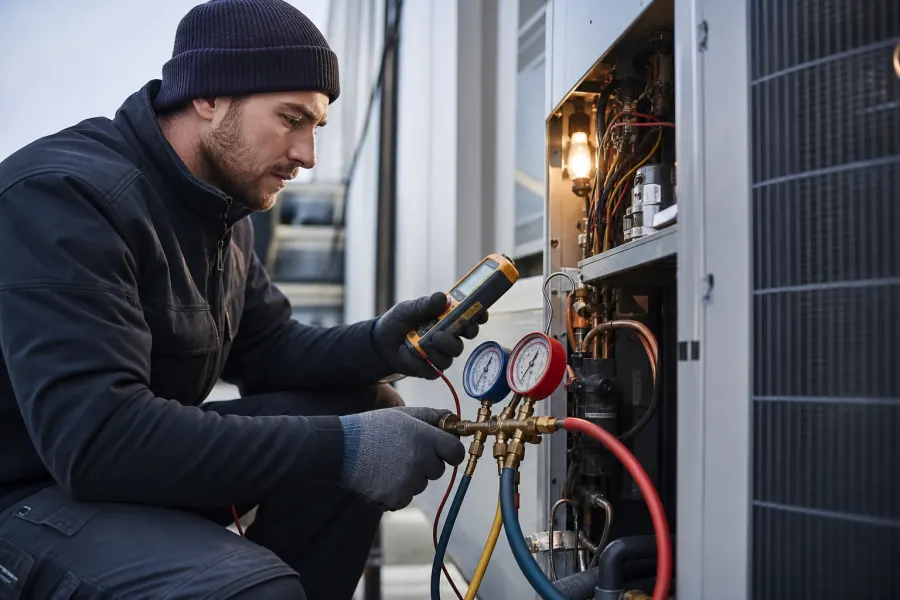
Roofs, attics, crawlspaces, heavy equipment, weather, burns, chemicals, and muscle strains are normal risks—not edge cases.
Schedule reality
Peak heating and cooling seasons may bring overtime, irregular hours, evenings, weekends, and emergency on-call work.
Career fit
A useful match includes the downsides.
Look closer if…
- You enjoy diagnosing a system whose electrical, mechanical, airflow, and control symptoms overlap.
- You can explain problems to customers and keep clear service records.
- You value a faster entry path and are willing to keep learning new equipment and refrigerants.
Think twice if…
- Extreme temperatures, roofs, confined spaces, or customer-facing service work are dealbreakers.
- You want a predictable schedule in every season.
- You assume one federal refrigerant credential replaces local mechanical or contractor licensing.
The path
From interested to employable
Check employer and local expectations
The federal refrigerant rule is national, but state and local licensing and employer education expectations vary.
Choose school, apprenticeship, or direct hire
Compare placement data, debt, lab time, recognized credit, and paid work—not the program's marketing headline.
Earn the right Section 608 certification
EPA requires covered technicians to pass an approved test; certification type depends on the equipment.
Build supervised diagnostic experience
Move from basic tasks into electrical testing, airflow, charging, controls, and systematic fault isolation.
Specialize or advance
Commercial refrigeration, controls, testing and balancing, sales, supervision, and contracting have different skill and license implications.
The real cost
School can be the largest cost when the chosen employer expects formal education. Also budget for EPA testing, gauges and meters only when required, PPE, boots, transportation, and an entry-period wage below an experienced technician's. Ask employers for their tool list before buying specialized instruments.
What technology is changing
Connected thermostats, variable-speed equipment, building automation, remote alerts, and AI-assisted diagnostics increase the value of controls and data skills. The technician still verifies symptoms at the equipment, handles refrigerants legally, makes safe repairs, and tests the result. The strongest path combines mechanical fundamentals with electrical and controls literacy.
Primary sources
Reviewed September 2, 2026. National data may not describe a specific employer or jurisdiction.
Keep going